Royal Rasoi | July 17, 2026




Before you even take a seat at a curry restaurant in Hanoi, you may determine whether it's authentic.
Do they grind the spices on site?
Is the menu varied enough to include different Indian cuisines?
Is the bread prepared fresh?
Do real Indian customers dine there?
The four questions matter because authentic Indian cooking strictly follows techniques and seasoning combinations, which can easily be faked on paper but not on the plate. This guide helps you distinguish a real curry house from a pretender.
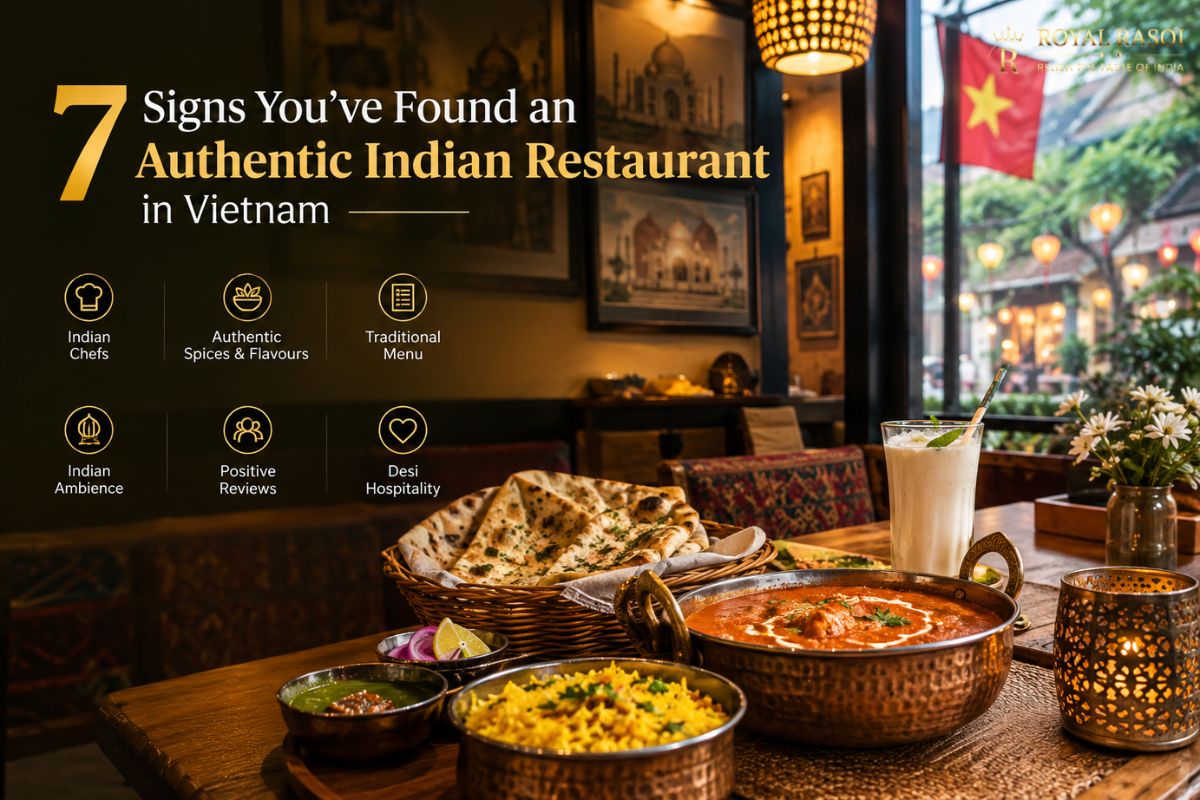
When evaluating an Indian restaurant for authenticity, one should keep an eye out for seven indicators:
However, if one of the indicators is present, it does not mean much—you must see some or all of them together to conclude that you are eating at a decent Indian restaurant instead of a generic barbecue place serving Indian food.
The biggest giveaway is whether a restaurant grinds and roasts its own spice blends, called masalas, instead of buying pre-packaged mixes.
Indian cooking layers spices at different stages:
If every curry on the menu tastes about the same whether it's a South Indian sambar or a North Indian rogan josh, that's usually shortcut cooking.
At a genuine North Indian restaurant in Hanoi, you'll notice differences even between dishes with similar base ingredients. Compare a dal makhani to a chana masala. Both are legume-based, but the tempering, the cumin-to-garam-masala ratio, and the finishing touches should taste distinctly different if the kitchen is actually mixing its own spices.
India's food varies enormously by region, and a restaurant that understands this usually shows it on the menu.
A menu that sticks to a narrow band of familiar dishes—butter chicken, chicken tikka masala, naan—with no regional distinction at all, is usually built for what tourists expect rather than what Indian food actually is.
That doesn't mean a restaurant has to cover every region to count as authentic. Plenty of well-regarded Indian restaurants specialize on purpose, sticking to North Indian cuisine, for example. What matters is that the specialization is deliberate and executed with real depth, not a shortcut menu wearing Indian names.
Therefore, Royal Rasoi in Hanoi is one example of a restaurant built around a specific regional identity rather than trying to cover everything at once. That kind of focus usually shows up in how consistent the dishes taste from one visit to the next.
Bread is one of the easiest things to check in person, since you can usually see or ask about how it's cooked.
Naan, roti, and paratha should come from fresh dough, cooked to order, ideally in a tandoor, a traditional clay oven that reaches very high heat and gives bread its characteristic char and puff. Frozen, reheated naan tends to be uniformly soft, with no char and a slightly rubbery texture once it cools.
Moreover, if you're hunting for the best Indian restaurant in Hanoi for tourists, try ordering a plain naan next to a garlic naan. If they taste nearly identical apart from the garlic, the base dough is probably mass-produced rather than made fresh that day.
Technique matters as much as ingredients in Indian cooking, and that comes down to who's actually in the kitchen.
Many strong Indian restaurants abroad, including in Hanoi, are staffed by chefs trained in India who bring specific techniques with them:
You can't always verify this directly, but it usually shows up in the food's consistency. Dishes that need precise timing, like biryani or a properly set dahi (yogurt), are hard to get right without real hands-on experience.
If a restaurant is willing to talk about where its chefs trained or how long they've been cooking Indian food, that's usually a good sign by itself.
A large share of India's population eats vegetarian food regularly, and Indian vegetarian cooking isn't just meat dishes with the meat taken out. It has its own techniques and its own depth.
To judge the best Indian vegetarian restaurants in Hanoi, look at how much of the menu is actually built around vegetables, lentils, and paneer, rather than two or three token dishes bolted onto a meat-heavy menu. Dishes like baingan bharta (smoky roasted eggplant), palak paneer, or a well-made dal should work as main dishes in their own right, not padding.
One practical marker: restaurants with a serious vegetarian section often keep separate cooking equipment or clear procedures to avoid cross-contact with meat, since that matters to many vegetarian diners for religious and dietary reasons.
Spice level in Indian cooking is about more than heat. It's a balance of heat, tang, sweetness, and aroma.
A restaurant that actually asks how spicy you want your dish, and then adjusts it instead of serving one fixed heat level to everyone, is usually paying closer attention to detail. This matters especially for a North Indian restaurant in Hanoi, since North Indian food often has a wider range of mild-to-moderate dishes compared to some South Indian preparations, which lean more on chili heat balanced with coconut and tamarind.
Furthermore, if every dish arrives at the same intensity no matter what you asked for, the kitchen is probably working off one base gravy instead of adjusting recipes individually.
This is the least technical sign, and maybe the most reliable one.
Hanoi has a growing Indian expat community, plus business travelers and long-term residents. If a restaurant regularly draws Indian customers, especially families or groups eating together rather than tourists on their own, that's a good sign the food holds up to a standard those diners already know from home. Indian diners tend to spot shortcuts quickly, since the flavors are familiar to them in a way they aren't to most visitors.
An empty restaurant isn't automatically a red flag, especially outside peak hours. But steady patronage from Indian diners over time is hard to fake.
A few direct questions can tell you a lot before the food even arrives:
Therefore, staff who answer clearly and specifically, instead of giving a vague or rehearsed response, are usually working in a kitchen that takes the food seriously.
| Sign | What to Look For | Why It Matters |
|---|---|---|
| Spice blends | House-ground vs. pre-packaged masala | Determines depth and distinctiveness of flavor |
| Menu structure | Regional focus vs. generic curry list | Reflects genuine culinary knowledge |
| Bread | Fresh dough, tandoor-cooked | Frozen bread lacks proper texture and char |
| Staff background | Indian culinary training | Affects technique-dependent dishes |
| Vegetarian menu | Dedicated dishes, not token options | Vegetarian Indian cooking has its own depth |
| Spice customization | Adjusted per dish and per request | Shows attentive, non-formulaic cooking |
| Customer base | Indian residents and expats dine there | Hard-to-fake authenticity signal |
You don't need culinary expertise to spot an authentic curry restaurant in Hanoi. Check the details: fresh spice blends, a menu with actual regional identity, properly cooked bread, a vegetarian section that's more than an afterthought, and Indian diners in the room. Places like Royal Rasoi, built around a specific regional focus rather than a catch-all menu, tend to show that consistency. Next time you're picking an Indian restaurant in Hanoi, run through these seven signs instead of going by the menu photos.
1. What's the biggest sign of an authentic curry restaurant in Hanoi?
House-made spice blends. They affect the flavor of every dish and are hard to fake with commercial curry powder.
2. Why does regional variety on the menu matter?
Indian food differs a lot by region. A menu with regional depth usually reflects real knowledge of the cuisine rather than a simplified tourist menu.
3. Is fresh naan really that different from frozen?
Yes. Fresh, tandoor-cooked naan has a distinct char and chew that reheated frozen naan doesn't have.
4. Can a restaurant be authentic without an Indian chef?
It's less common. A lot of the technique-heavy dishes rely on hands-on experience that usually comes from working in Indian kitchens directly.
5. How do I find the best Indian restaurant in Hanoi for tourists that's still authentic?
Look for regional focus, fresh bread, and a customer mix that includes Indian diners, not just a menu built around familiar dishes like butter chicken.
6. Do the best Indian vegetarian restaurants in Hanoi need to be fully vegetarian?
No. Plenty of solid options are mixed restaurants with a genuinely deep vegetarian section rather than exclusively vegetarian places.
7. Does spicier mean more authentic?
No. Authentic spicing is about balance, and adjusting heat to the dish and the diner, not maximizing chili.
8. What's a simple test on a first visit?
Order a plain naan and ask for a dish at your preferred spice level. Judge by the texture, the char, and whether the heat actually matches what you asked for.
Reserve your table at Royal Rasoi and experience the finest Indian cuisine in Hanoi with family, friends, or colleagues.
 Book Your Table