


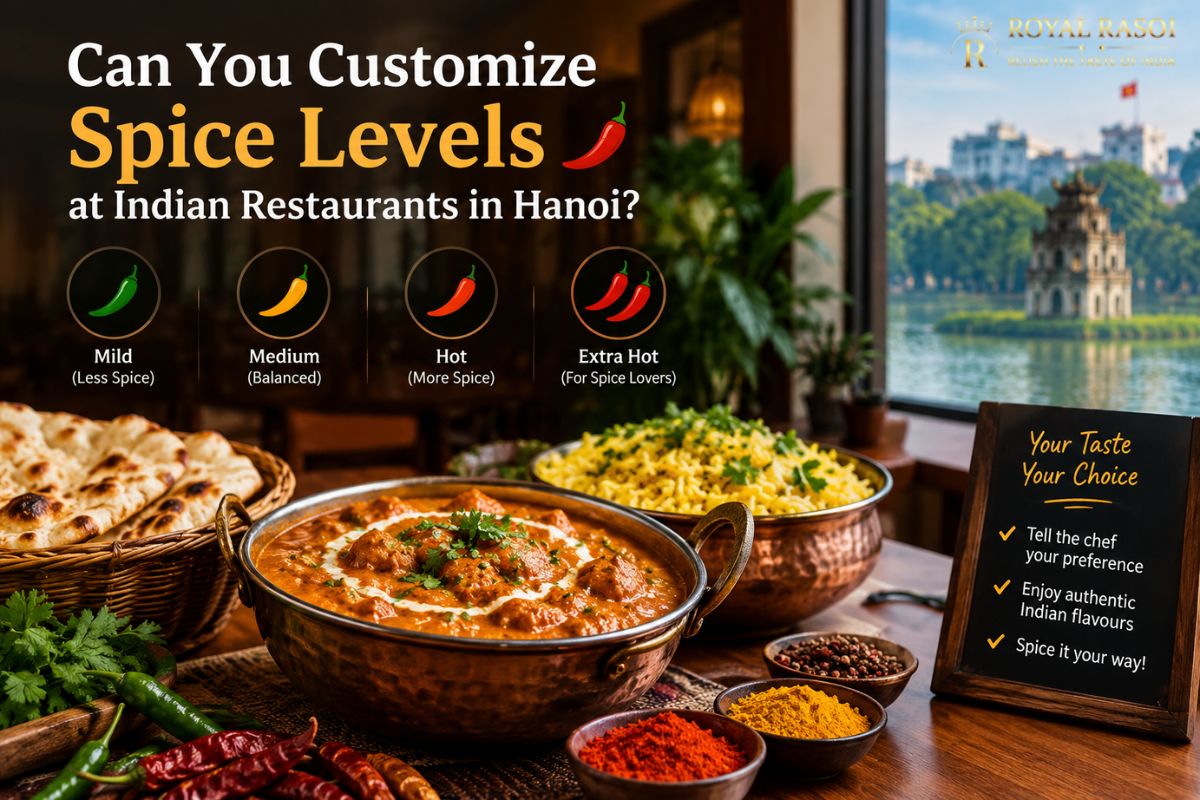
Can You Customize Spice Levels at Indian Restaurants in Hanoi?
Key takeaways
- Most Indian kitchens in Hanoi can regulate spices, so please inform your server.
- Real Indian food is about layers of flavour and not just heat from the chilli.
- Begin with mild or medium, then request chilli on the side.
- Spice levels differ by dish, so describe your limit, not a label.
Can you really ask for a different spice level?
Generally, yes. A lot of Indian recipes begin with a flavour as a foundation, consisting of onion, tomato, ginger, garlic and spices. The heat from chilli is only one element of the overall base, and a cook could underuse it without altering the base too dramatically.
However, there are boundaries. Some restaurants prepare sauces in larger batches ahead of service. In that case, the kitchen may only be able to adjust the final stage of cooking, or give you extra chilli on the side. For other dishes, a chilli-heavy plate is the point of the dish, so a mild one will taste very different.
You can always ask your server what is possible for the dish you like. A good team will be honest with you.
Spice, chilli heat and flavour: what is the difference?
People often assume all these three words mean the same. But they don’t.
- Spice refers to all types of seasonings, including cumin, coriander, cardamom, turmeric, and a lot of others. Most of the seasonings add aroma, warmth, or earthiness, but not hotness.
- Chilli heat is derived from chillies. It refers to the feeling of burning in your mouth and running nose.
- Flavour is the whole picture of seasoning: spices, salt, sourness, sweetness, cream, and herbs, and how they work together.
Korma can have cardamom and still be light on heat. Additionally, dal can have strong spicing but still be soft. When searching for an authentic curry restaurant in Hanoi, evaluate the restaurant based on its spice combination and aroma, not heat.
Which common Indian spices add heat?
Fewer than most people expect. Here is a quick guide.
| Spice | What it adds | Adds chilli heat? |
|---|---|---|
| Cumin | Earthy, warm flavour | No |
| Coriander seed | Light, citrusy note | No |
| Turmeric | Colour and mild earthiness | No |
| Cardamom | Sweet, floral aroma | No |
| Cloves and cinnamon | Warm, sweet depth | No |
| Black pepper | Sharp, pungent bite | Mild |
| Ginger and garlic | Pungent, savoury base | Mild warmth |
| Mustard seeds | Nutty, slightly sharp | Mild |
| Kashmiri chilli | Deep red colour | Usually mild |
| Green chilli | Fresh, sharp heat | Yes |
| Red chilli powder | Strong, lingering heat | Yes |
Therefore, Garam masala is a mixture of warming spices. The heat of the blend varies based on the recipe and is often used for fragrance rather than heat in many kitchens.
What do mild, medium, hot, and extra hot mean?
No set rules, so consider this a very general guideline.
Mild
Almost no heat. The food is flavourful, creamy, and aromatic. The dish is very child-friendly and also works well for first-time diners.
Medium
A comfortable level of warmth that most people will be able to cope with. If you find yourself popping chilli into your home-cooked noodles or soup, this is a good starting point.
Hot
Turn up the heat as you continue to snack. This is for those who are chilli lovers.
Extra Hot
Certain food will be cooked this way if you request it, but see this as a request, not an assurance. Go for less if you are not sure. Extra heat is at your table in chilli sauce and green chillies – it's not so easy to remove when the dish is cooked in.
Why does spice level change from dish to dish?
Each dish uses chilli differently. A cream-based curry and a tangy tomato curry will not feel the same, even if both are labelled "medium".
| Dish style | Usual spice character | Worth knowing |
|---|---|---|
| Creamy curries (korma, butter-style, makhani) | Mild and rich | Easy to keep gentle |
| Dal (lentils) | Mild to medium, tempered with cumin and garlic | Tempering can often be adjusted |
| Chickpea and vegetable curries | Medium and tangy | Ask how hot the standard version is |
| Tandoori and tikka | Marinated, then grilled | The marinade is made earlier, so ask |
| Biryani | Aromatic, often moderate | Cool it with raita |
| Vindaloo and similar | Hot and sharp | Built around heat |
| Chaat and snacks | Tangy, sweet, with chutneys | Ask for chutneys on the side |
Moreover, these are general patterns. Recipes differ between kitchens, so use the table as a guide, not a rule.
How do you explain your spice preference clearly?
Don't use the one-word "spicy" and provide your server with something more meaningful. Here are some lines that can be used:
• Give it medium spice, but not too hot.
• “Make it very mild because I'm not used to eating chilli.”
• “Can you keep the dish mild and add green chillies as a side dish?”
• Is this creamy or tangy, and how hot is it normally?
Some of the Vietnamese vocabulary will assist as well. Không cay means not spicy, ít cay means less spicy, cay vừa means medium spicy, and rất cay means very spicy. While English can do the job, a little "English" goes a long way.
Additionally, it's also useful to let others know how you deal with chilli in your everyday life. If it's chilli with noodles, you know what it is from the kitchen, more than any label.
Practical tips for different diners
Tourists
If you have to find the best Indian restaurant in Hanoi for tourists, make sure that the menu is legible in English, and that they are willing to explain their dishes. Order 2-3 items to share. Pick one mild and one medium, so you can make a comparison before you make your decision. Include rice or bread in each meal.
Families With Children
Please request mild food items and have chilli sauce available as well, so adults can make up their own mind whether to add some. Easy options are creamy curries, plain rice and naan. If possible, ask the kitchen to cook the children's meal before adding the chilli.
Vegetarians
Generally, vegetarian Indian cuisine, like paneer, dal and vegetable curries, is quite simple to tweak, as the chilli is added with the other spices. In case of a strict veggie diet, inquire about how food is prepared. Do not assume.
Diners New to Indian Spice
- Begin with a mild or medium flavor.
- Don't place multiple entrée orders at a time.
- Have a plate of rice, bread, and raita on hand to ease the heat.
- Eat a little quantity of new foods before.
How do you choose an Indian restaurant?
If you're looking for the best Indian restaurants in Hanoi, you'll find there are a lot of lists out there. The best test of a restaurant is the answer to the question. The same applies if you're searching for the best Indian food in Cau Giay
- When ordering, staff ask if you prefer your food spiced or not.
- The menu explains what they serve, not only their names.
- Chutneys, raita or chilli may be served as a side dish.
- The team will be able to advise you which dishes are mild and which aren't.
Furthermore, reviews can help, but read the reviews to get a feel for how they operate and the consistency of their services. What's hot for one is hot for another.
What if your food turns out too spicy?
Reach for dairy. Yoghurt, raita, and lassi (when available) will help alleviate chilli heat more effectively than water. Rice and bread is also helpful as it soaks up the sauce.
Explain this to the server as well. They may be able to bring something cooling or suggest a milder dish to share at the table.
Bottom line
Indian restaurants in Hanoi tend to be quite spicy, but it's a matter of communication. Talk about how you add chilli, not as much as you think you need, and add extras on the side. Keep in mind that flavor is not just about the heat- the entire array of spices.
When ordering food at Royal Rasoi or any other best Indian restaurants in Hanoi, make sure to inform the group at the beginning of your meal. Before placing the order, a brief chat sometimes has more impact than the name of the dish on the menu.
Frequently asked questions
1. Can I ask for less spicy food at an Indian restaurant in Hanoi?
Yes, you can ask. The amount of chilli can be reduced in many dishes in most kitchens, although in some pre-made sauces, this may be impossible. Check with the server before placing an order.
2. How do I say "not spicy" in Vietnamese?
For spicy answer: không cay (not spicy), for less spicy answer: ít cay (less spicy). These phrases will make your request clearer if it is understood in English.
3. Is Indian food always spicy?
No. There are a lot of mild and aromatic dishes. Spices give flavour, and only chillies give burning heat.
4. Which Indian dishes are mild for beginners?
Common starting points are cream curries, milder dal, biryani, and tandoori dishes with a light serving of chilli. Inquire from your server what the least objectionable dishes are.
5. Can vegetarians customize spice levels too?
Yes. Most vegetarian curries and lentil dishes can be modified. When ordering, be sure to state any dietary requirements explicitly.
6. What does extra hot mean at an Indian restaurant?
Generally refers to more chilli than the hot option, though that is not always the case, depending on the kitchen. Don't place an order until you ask what the actual temperature is.
7. Can children eat Indian food?
Children like mild curries like creamy curries, rice and naan. Request a minimum amount of chilli or have any additional heat reserved.
8. Should I ask for chilli on the side?
If you're not sure, then it's a good idea. Heat may be added gradually, but can never be removed once cooked.